
 Odds & Markets
Odds & Markets
Odds & Markets
Sports Betting Odds & Markets — Moneyline, Spreads & Totals
Sports betting odds are the price attached to an uncertain sporting outcome. They indicate how a market is currently being priced, but they are not permanent predictions and should not be read as guarantees about what will happen. A football moneyline, NFL spread, NBA total or player prop can move after injuries, confirmed lineups, market activity or other new information, which means the exact number and the time at which it was observed are fundamental parts of any betting analysis.
The Odds & Betting Markets section of sport-betting.us.com is designed as the market-information layer of the site. It brings together current betting lines, moneylines, spreads, totals, props and longer-term markets while explaining how those prices work and how they can change. The objective is not to tell readers that one price is automatically a good bet, but to make the market understandable enough that they can distinguish the sporting outcome from the price being offered on that outcome.
This separation is important across the site architecture. Picks & Predictions focuses on the analytical case for or against a particular wager. Odds & Betting Markets focuses on what the market is, what price is currently available and how that number should be interpreted. Sportsbooks & Bonuses covers the operators and commercial terms through which those markets may be offered. Keeping those functions distinct makes it easier to separate editorial analysis from sportsbook promotion and avoids turning a market page into an advertisement.
Live Sports Betting Odds and Lines
Live odds should be treated as dynamic data rather than permanent editorial facts. The number displayed for an event can move before the game begins and, where in-play betting is available, can change repeatedly after the event starts. For that reason, every current-odds component should show the relevant timestamp or last-update state so readers know whether they are viewing a current market or a previously published reference price.
The core live-lines experience should allow users to understand the principal market attached to a game without first navigating through a long educational article. Event, market type, current line and update time should be immediately visible. More detailed explanations can then provide context for readers who want to understand the difference between a moneyline, spread or total.
A live odds page also needs to distinguish the market itself from editorial interpretation. A team being listed as the favorite describes the current market price; it does not mean sport-betting.us.com is recommending that side. Likewise, an underdog price reflects the relationship between possible return and implied probability, not a statement that the team is unlikely to compete.
Current odds should therefore serve as a reference point for analysis rather than as a conclusion.
How Betting Odds Represent Price
Odds express the price of a wager and can also be converted into an implied probability. In an American-odds format, negative numbers generally indicate how much would need to be risked to generate a defined unit of profit, while positive numbers indicate the potential profit associated with risking that unit. The precise interpretation depends on the market and sportsbook rules, but the central principle is that the odds define the price attached to the outcome.
For negative American odds, implied probability can be calculated as:
Implied probability = |odds| / (|odds| + 100)
For positive American odds:
Implied probability = 100 / (odds + 100)
For example, odds of -110 correspond to an implied probability of approximately 52.4%. Positive odds of +150 correspond to an implied probability of 40%. These calculations describe the probability embedded in the quoted price before a reader makes any separate assessment of whether that price represents value.
The distinction matters because a likely outcome can still be unattractive at the wrong price. A team estimated to win 70% of the time would not automatically represent value at any odds; the offered price would still need to be compared with that estimate. Odds are therefore not merely labels identifying favorites and underdogs. They are the financial side of the probability assessment.
American Odds
American odds are particularly relevant to sport-betting.us.com because the site uses English (US) while serving a worldwide audience. The format generally presents favorites with negative numbers and underdogs with positive numbers, although equal or near-even markets may appear close to the zero boundary depending on the sportsbook.
A negative number should not be interpreted as a prediction that the outcome is certain. It indicates how the market currently prices that outcome relative to the alternatives. Similarly, positive odds do not mean the outcome is a poor bet by definition; they indicate a lower implied probability and a correspondingly different potential return.
Readers should also understand that the same event may be displayed in different odds formats on different services or in different regions. The underlying market can remain the same even when the visual representation changes. For a US-oriented site, American odds can be the default presentation, while educational content should still explain implied probability so the meaning of the number remains clear.
Moneyline Betting
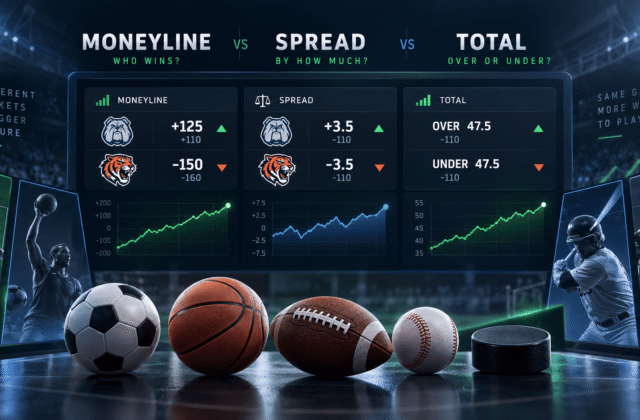
The moneyline is one of the most direct betting markets because it generally concerns which side wins according to the settlement rules of the event. The apparent simplicity can be misleading, however, because evaluating a moneyline still depends on price. Choosing the stronger team is not the same thing as identifying value.
Suppose one side is heavily favored. The market may correctly indicate that the team has a higher probability of winning, but the potential return may be small relative to the risk implied by the line. An underdog has the opposite structure: lower implied probability but greater potential return. Neither side becomes automatically preferable solely because it is favored or because it offers a larger payout.
Moneyline analysis should therefore connect three pieces of information: the estimated probability of the sporting outcome, the implied probability of the current price and the uncertainty around that estimate. The live market supplies the odds; prediction content can then assess whether the price is worth considering.
Settlement rules can vary by sport and market, so the event-specific sportsbook rules remain important. Overtime, extra time, listed pitchers or other sport-specific conditions can affect how certain wagers are graded, and readers should verify the applicable terms before betting.
Point Spreads and Handicap Markets
A spread changes the question from simply identifying the winner to evaluating the expected margin. One team may be assigned a negative handicap while the opposing side receives a positive number, creating a market based on whether the final result covers that line.
This creates a fundamental distinction between winning the game and covering the spread. A favorite can win the event while failing to cover, while an underdog can lose the game and still satisfy the spread condition. For that reason, spread analysis requires a different probability assessment from moneyline analysis even when both concern the same matchup.
The exact number matters. A prediction made at one spread cannot automatically be carried over after the market moves several points. The reasoning may still favor the same team, but the threshold that needs to be covered has changed, which changes the wager itself.
A spread should therefore always be displayed together with the price and timestamp used for the analysis. Describing a team simply as “the pick against the spread” without preserving the actual number removes one of the most important pieces of information from the recommendation.
Totals and Over/Under Markets
Totals markets focus on combined scoring rather than which side wins. A sportsbook posts a number, and the market is generally divided between outcomes above and below that threshold according to the relevant settlement rules.
Totals analysis requires different evidence from side selection. Offensive efficiency, defensive performance, pace, weather, starting personnel and sport-specific factors can all influence expected scoring. In NFL betting, for example, weather or quarterback availability may materially change scoring expectations. In NBA markets, player availability and tempo can affect a total. In MLB, starting pitchers and bullpen context may matter, while NHL totals can respond to goaltending and team style.
The posted total already reflects market expectations, so identifying two high-scoring teams does not automatically make the Over attractive. If that expectation is widely recognized, the sportsbook may have posted a correspondingly high number. The useful analytical question remains whether the current line is higher or lower than the outcome distribution the available evidence supports.
Just as with spreads, line movement matters. An Over considered at one number may become materially less attractive after the total rises, while an Under may change significantly if the market falls.
Betting Lines and Why the Number Matters
The phrase betting line can refer broadly to the number defining a market. On a moneyline, the price itself is the key number. On a spread, both the handicap and attached odds matter. On a total, the scoring threshold and price matter. Props and futures add their own market-specific structures.
The critical editorial principle is that a market cannot be separated from its number. “Bet Team A” contains less information than “Team A at the published moneyline,” while “take the Over” is incomplete without the corresponding total. When sport-betting.us.com publishes a market or prediction, the current reference line should therefore remain visible.
This also helps prevent outdated analysis from being mistaken for a current recommendation. If an article explains why +3.5 was attractive but the market later trades at +1.5, readers can see immediately that the available bet is no longer identical to the one analyzed.
Odds Movement
Odds movement occurs when the market price changes. A moneyline may shorten or lengthen, a spread can move from one number to another, and totals can rise or fall. Because the original site specification explicitly includes Odds Movement as part of betting news, this should be treated as an editorial topic rather than merely a technical feature of a live odds feed.
The important question is not simply that a line moved, but what is known about the timing and context. A meaningful injury update, confirmed lineup or other material information can coincide with market movement. In other situations, a line can move without a publicly confirmed single cause. FootballNews or SportNews may provide the sporting information, while sport-betting.us.com explains the corresponding market change.
Reporting should avoid inventing explanations. If the reason for a movement cannot be verified, the article should describe the change without claiming that a specific group of bettors, injury or piece of information definitely caused it.
The timestamp remains essential because line movement is chronological. Readers need to know the earlier number, the later number and when the change occurred in order to understand the market properly.
Opening Lines and Current Odds
The opening line is the earlier market price made available for an event, while the current line reflects the market at a later point in time. Comparing the two can show how the price has changed, but movement alone does not prove whether the opener or current number is more accurate.
An opening favorite becoming shorter may indicate that the market now assigns a higher implied probability to that side. A spread moving in the favorite’s direction increases the margin the favorite needs to cover. A total moving upward increases the threshold for an Over and lowers it for an Under in practical terms.
For editorial purposes, the comparison should be descriptive. sport-betting.us.com can show that a market changed from one point to another and explain relevant confirmed news that occurred during the same period, but it should not imply that every movement predicts the final result.
This distinction protects the site from a common betting-content error: treating the market itself as if it were a forecasting oracle.
Comparing Betting Odds
When several legal and available sportsbooks offer the same event, their displayed prices may not always be identical. That makes price comparison a relevant part of market analysis because even relatively small differences can change implied probability and potential return.
The Odds & Betting Markets section can therefore show multiple current prices where technically and legally appropriate, but it should maintain clear timestamps and identify the operator attached to each quote. A stale price from one source should not be displayed next to a current price from another as though the two were observed simultaneously.
Price comparison should also remain separate from sportsbook evaluation. The fact that one operator displays a particular line at one moment does not establish that it is generally superior. Broader operator assessment belongs in Sportsbooks & Bonuses, where licensing, availability, terms, product and evaluation methodology can be considered together.
For readers, the practical lesson is simple: the exact price matters. Comparing the same market across available operators can reveal differences, but local legality and sportsbook terms must still be checked before any real-money action.
Player Prop Markets
Player props focus on individual performance outcomes rather than the overall result of a game. Depending on the sport, markets may relate to scoring, passing, rushing, assists, rebounds, shots or other measurable statistics. The exact offerings vary by event and sportsbook, so a market page should display the live proposition rather than assume that a particular prop is universally available.
Prop lines can change quickly after injuries or lineup announcements because an individual player’s expected role may increase or decrease. A basketball player receiving additional minutes, an NFL receiver becoming more important after a teammate’s absence or a baseball player moving in the lineup can materially change how a prop is priced.
The same line discipline applies here as elsewhere. A prediction on a player total at one number cannot simply be reused after that total moves. The market threshold is part of the analysis.
Because props create a large number of potential markets, editorial coverage should remain selective. The goal is not to generate content for every available line, but to explain markets where the underlying assumptions can be meaningfully analyzed.
Futures Markets
Futures concern outcomes settled over a longer period, such as season achievements or tournament results. They differ from single-game markets because the underlying probability can change repeatedly before settlement as performance, injuries, transfers and schedules evolve.
A futures price therefore needs an especially clear date. An offseason line may be very different several weeks into a season, and analysis based on the earlier roster or competitive environment may no longer be valid after major changes.
The fact that a potential payout is larger than that of a short-priced single-game wager does not automatically mean the market offers more value. The time horizon, uncertainty and implied probability all remain part of the evaluation.
Futures content should therefore emphasize the current price and the assumptions behind the analysis rather than treating long odds as inherently attractive.
Live and In-Play Betting Markets
Where legally available, in-play markets allow odds to change during an event based on the developing game state. The market can react to score, time remaining and other event information, which makes the data substantially more dynamic than pregame betting.
Because the number can change rapidly, a static article should not present an in-play price as though it remains current. Live market interfaces need continuous updates and clear status information, while editorial content should explain how the market type works without pretending that a price observed minutes earlier is still available.
In-play betting also increases the risk of impulsive decisions because the time between seeing a line and acting on it can be short. Responsible Gambling information should therefore remain accessible within the live betting environment rather than being isolated elsewhere on the site.
The objective of the page should be to explain market mechanics and current information, not to pressure readers into acting quickly simply because odds are moving.
Football Betting Odds
Football should form one of the largest sport-specific odds hubs because the site brief identifies Football Betting Tips as a major traffic section and specifically includes the Premier League and Champions League. The odds layer can organize current match markets while leaving the actual predictions to the separate Picks & Predictions section.
Football market pages can surface moneylines or equivalent match-result pricing, spreads or handicaps, totals and other supported markets according to the event. The important editorial distinction is that availability can vary by sportsbook and jurisdiction, so the site should not present every market as universally accessible.
Team news and competition context should link naturally to FootballNews.us.com, while the odds page remains focused on price and market structure. This gives readers a route from the betting number to deeper sporting information without duplicating an entire match preview.
NFL, NBA, MLB and NHL Odds
The original sport-betting structure separately identifies NFL / NBA / MLB / NHL Betting, so the Odds hub should provide strong league-specific paths rather than collapsing all North American sports into a generic list.
NFL odds pages can organize moneyline, spread and totals markets while reflecting the importance of late injury and weather information. NBA markets need rapid updates because player-status changes can materially affect lines close to tipoff. MLB odds often depend heavily on current starting-pitcher and lineup information, while NHL prices can respond to expected goaltenders and other availability developments.
The data architecture should remain consistent across sports even when the analytical inputs differ. Readers should always be able to identify the event, market, current line and last update time. Sport-specific analysis can then explain why those numbers may have moved.
Odds, Predictions and the Difference Between the Two
One of the most important structural decisions for sport-betting.us.com is keeping odds and predictions connected without making them interchangeable. The odds describe the current market. The prediction evaluates whether a particular market may be attractive according to an analytical process.
A team can be priced as a favorite without being a recommended pick. An analyst can expect the favorite to win while deciding that the current moneyline offers insufficient value. Similarly, a prediction can change even when the sporting opinion remains broadly the same because the market price moved enough to alter the risk-return relationship.
This distinction creates cleaner internal linking. The Odds page can show the current line; the Picks page can explain an editorial assessment; SportNews or FootballNews can provide the underlying sporting context. One event can therefore support several useful pages without duplicating their purpose.
Odds and Sportsbook Availability
A market is useful only if the reader can legally and practically access it. Sports betting regulation differs across countries and, in some jurisdictions, across states or other subnational regions. The existence of an operator somewhere in the world does not establish that the same sportsbook or market is legal where the reader lives.
sport-betting.us.com should therefore adapt sportsbook and promotional information to the user’s jurisdiction where technically possible and avoid presenting worldwide availability as a legal conclusion. Readers should be directed to verify current local rules, minimum age and operator availability before using real-money services.
This is especially important on odds-comparison pages. Displaying a price from an operator should not imply that every reader is eligible to open an account or place the corresponding bet.
Detailed reviews, licensing information, promotional conditions and the site’s operator evaluation methodology belong in the next major silo, Sportsbooks & Bonuses.
Timestamps and Dynamic Market Data
Odds are among the most time-sensitive pieces of information on the entire website. A number can be correct when published and wrong several minutes later without the original data source having made an error. The solution is not to pretend the price is permanent, but to show clearly when it was captured or last refreshed.
This requirement should apply to current lines, prediction references and odds-comparison tables. If automated updates stop or a feed becomes unavailable, the interface should not continue presenting an old number as live.
Editorial articles can preserve historical prices when they are relevant to the story. In that case, the wording should make clear that the figure represents the market at that time, not the current line.
That distinction improves both accuracy and reader trust because it explains why the number in an older article may differ from the live odds visible elsewhere on the site.
Responsible Gambling and Betting Markets
Understanding odds does not remove the financial risk of betting. A line expresses price and implied probability; it does not eliminate uncertainty about the event. Even if a reader believes the market is mispriced, the wager can still lose.
Betting budgets should be set before wagering, and losses should not be chased by increasing stakes. Readers should never use money required for essential expenses, and self-exclusion or gambling-support resources should remain visible throughout the betting section.
Minimum age and legal availability vary by jurisdiction and may be 18, 21 or another locally defined threshold. sport-betting.us.com should display the appropriate age and regulatory messaging according to geography rather than assuming one worldwide standard.
No odds page, market explanation or line movement should be framed as proof of guaranteed profit.
How Odds & Betting Markets Fits the sport-betting.us.com Structure
The site’s three main commercial and informational silos now serve distinct purposes. Picks & Predictions handles analysis and selections. Odds & Betting Markets provides the current prices, market mechanics and line movement. Sportsbooks & Bonuses evaluates the operators, promotional terms and commercial products through which betting may be available.
This separation matters both editorially and for user intent. Someone searching for a prediction wants an argument about an event. Someone searching for odds wants the current price. Someone researching sportsbooks wants to evaluate an operator. Combining all three into one page would weaken the usefulness of each.
Internal linking should therefore follow the reader’s decision path without forcing commercial promotion into every article. A match odds page can link to a relevant prediction, and that prediction can link to deeper sporting coverage. Sportsbook information should appear where operator choice is genuinely relevant and should remain clearly labeled.
Frequently Asked Questions About Sports Betting Odds
What are sports betting odds?
Betting odds are the price attached to a possible outcome. They can be converted into an implied probability and are used to determine potential returns according to the sportsbook’s rules.
Why do betting odds change?
Lines can move as the market and available information change. Injuries, lineup announcements and other developments may coincide with movement, although a specific cause should not be assumed unless it can be verified.
What is a moneyline?
A moneyline generally prices which side will win according to the market’s settlement rules. The quoted odds determine the price rather than changing the scoring margin.
What is a point spread?
A spread introduces a handicap or margin into the wager. A team can win the actual event but fail to cover the spread, or lose the event while covering as an underdog.
What does Over/Under mean?
A totals market sets a scoring threshold. The Over relates to combined scoring above that line and the Under to scoring below it, subject to the market’s settlement rules.
What does -110 mean in American odds?
It corresponds to an implied probability of approximately 52.4% before broader analytical uncertainty is considered. The number represents price, not a guarantee about the outcome.
Are odds the same at every sportsbook?
Not necessarily. Current prices can differ, which is why comparisons need timestamps and operator identification.
Does line movement mean a bet will win?
No. Movement describes a change in market price. It does not determine the future result of the sporting event.
Are live odds always current?
They should be timestamped or updated automatically, but readers should still check the current market immediately before acting because odds can change rapidly.
Are sports betting odds legal everywhere?
No. Sports betting regulation and operator availability vary by jurisdiction. Readers must verify local law, minimum age and the status of the relevant operator where they live.
Sports Betting Odds as Market Information, Not Certainty
Sports betting odds are most useful when they are understood as changing prices rather than predictions carved in stone. A moneyline reflects one market structure, a spread changes the question to margin, a total focuses on scoring and props or futures create more specialized outcomes. In every case, the exact number matters.
The Odds & Betting Markets hub gives sport-betting.us.com the infrastructure to organize those prices across football, NFL, NBA, MLB and NHL while keeping timestamps, implied probability and line movement visible. Current data answers what the market is offering now; educational content explains what that market means; prediction pages can separately evaluate whether the price deserves consideration.
That division supports a more responsible approach to betting content. The market can be analyzed, compared and explained, but it cannot remove uncertainty. Lines change, models can be wrong and every real-money wager carries financial risk.